Category 1B classification and the relative photoinitiators
Under the European Chemicals Agency (ECHA) and the Classification, Labelling and Packaging (CLP) Regulation, a "Category 1B" classification is used for substances that are presumed to have severe, long-term adverse health effects on humans. This classification is primarily based on animal studies.
The 1B classification applies to three types of hazards:
- Carcinogenicity (Carc. 1B): The substance is presumed to cause cancer in humans, with classification largely based on positive results from animal studies. Example: Formaldehyde was reclassified as Carcinogen Category 1B after an evaluation of animal data.
- Germ Cell Mutagenicity (Muta. 1B): The substance is presumed to cause heritable genetic mutations in humans. Classification is based on positive mutagenicity test results, typically from mammalian studies.
- Reproductive Toxicity (Repr. 1B): The substance is presumed to be toxic to human reproduction, meaning it may impair fertility or cause developmental harm to offspring. This classification is primarily based on clear evidence from animal studies.
Context within the CLP regulation
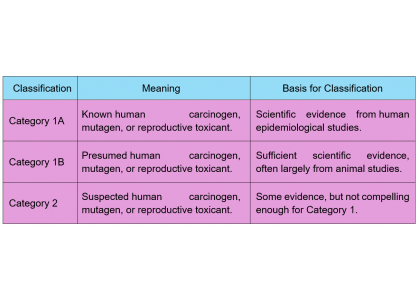
The 1B classification is part of a tiered system for carcinogenic, mutagenic, and reprotoxic (CMR) substances, which are of particular concern in the European Union.
|
Classification
|
Meaning
|
Basis for Classification
|
|
Category 1A
|
Known human carcinogen, mutagen, or reproductive toxicant.
|
Scientific evidence from human epidemiological studies.
|
|
Category 1B
|
Presumed human carcinogen, mutagen, or reproductive toxicant.
|
Sufficient scientific evidence, often largely from animal studies.
|
|
Category 2
|
Suspected human carcinogen, mutagen, or reproductive toxicant.
|
Some evidence, but not compelling enough for Category 1.
|
Regulatory consequences
A Category 1B classification triggers significant regulatory restrictions and requirements in the EU, including:
- Authorization: The use of substances classified as Carc. 1B, Muta. 1B, or Repr. 1B may require authorization from ECHA under the REACH regulation.
- Substances of Very High Concern (SVHC): A substance that meets the criteria for a Category 1B CMR is considered an SVHC and may be added to the Candidate List for eventual regulation under authorization.
- Product bans: Category 1A and 1B CMRs are subject to cut-off criteria, meaning they are banned for certain uses, such as in cosmetics and pesticides.
- Labeling: Products containing Category 1B substances must carry specific hazard statements (e.g., H340 for mutagenicity, H350 for carcinogenicity, H360 for reproductive toxicity) and pictograms to warn users.
As of September 16, 2025, Photoinitiators that have been classified as Category 1B Carcinogenic, Mutagenic, or Reprotoxic (CMR) substances by the European Chemicals Agency (ECHA) include:
Category 1B Reprotoxic photoinitiators
- 4-Phenylbenzophenone (4PBZ): Classified as a presumed human reproductive toxicant (Reprotoxin 1B) by ECHA in 2018, affecting its use in many applications, such as sensitive packaging.
- Ethyl-4-(dimethylamino)benzoate (EDB): Along with EHA, this was reclassified by ECHA in 2018 as Reprotoxin 1B, making it difficult to use for certain applications, including sensitive packaging.
- 2-Ethylhexyl-4-(dimethylamino)benzoate (EHA): Reclassified as Reprotoxin 1B in 2018, alongside EDB, restricting its use in applications such as sensitive packaging.
- Bis(2-(dimethylamino)-2-benzyl-1-oxobutyl)phenylphosphine oxide (commonly known as photoinitiator 369): The photoinitiator 369 and its alternatives have been subject to close regulatory scrutiny, with this compound identified as a presumed reproductive toxicant (Repr. 1B), leading to calls for its replacement in many products.
Category 1B Mutagenic photoinitiator
- 2-Methyl-1-[4-(methylthio)phenyl]-2-morpholinopropan-1-one (photoinitiator 907): ECHA legally categorized this substance as a category 1B presumed mutagen in 2017. Its status as a mutagen, based on animal studies, prompted solder resist manufacturers to find safer alternatives.
Category 1B Carcinogenic photoinitiator
- 2,4,6-Trimethylbenzoyldiphenylphosphine oxide (TPO): TPO was reclassified by ECHA in 2023 from a suspected human reproductive toxicant (Category 2) to a presumed reproductive toxicant (Category 1B). This move was based on animal study data showing negative effects on reproductive organs.