Call us now:
86-22-8834 5196
LIFTCHEM-UV Curing Raw Materials, Pharmaceutical Intermediates
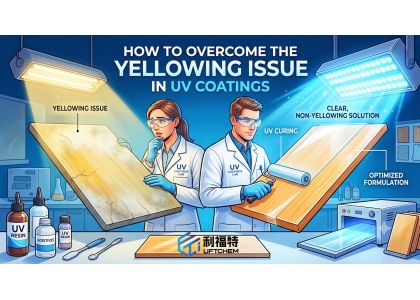
How to Overcome the Yellowing Issue in UV Coatings
Why are UV coatings prone to yellowing?
The yellowing of UV coatings stems primarily from their chemical composition and curing mechanisms. The main reasons are as follows:
1. Aromatic structures in the resin system
Core reason: Most cost-effective UV coatings utilize aromatic polyurethane acrylates as the primary resin. Their molecular structures contain benzene rings. Upon absorbing ultraviolet (UV) light, these benzene rings undergo photo-oxidation reactions, generating chromophores—such as yellow quinone-type structures—that cause the coating to yellow. This is the most significant and common cause of yellowing in UV coatings.
Analogy: Just as white paper yellows after prolonged exposure to sunlight—a process fundamentally caused by the photo-oxidation of lignin (which contains aromatic rings) within the wood fibers—UV coatings yellow due to similar chemical changes.
2. Photoinitiators and their residues
Impact of the initiator itself: Certain photoinitiators (such as α-hydroxy ketones like ECure 1173 and ECure 184) produce yellow decomposition products after absorbing UV light, in addition to generating the free radicals that trigger polymerization.
By-products: During the curing process, if the photoinitiator does not decompose completely, or if its fragments undergo side reactions with oxygen or the resin, colored substances may be formed.
Post-curing yellowing: After the coating has cured, residual photoinitiators or fragments may continue to react upon subsequent exposure to UV light, causing the coating to gradually yellow over time.
3. Influence of processing and usage environments
Over-irradiation (yellowing): During UV curing, excessive UV energy or prolonged exposure times can lead to over-crosslinking and degradation of polymer molecular chains, resulting in yellowing.
Oxygen inhibition: During surface curing, oxygen consumes free radicals, leading to incomplete surface curing and the formation of unstable substances like peroxides; these substances can easily trigger subsequent yellowing.
Thermal aging: High-temperature environments accelerate the oxidation reactions of the resin and photoinitiator residues, synergistically contributing to yellowing.
Contact with chemical substances: Exposure to nitrogen oxides (NOx) in the air can lead to nitration reactions, producing yellow substances.
Can the incorporation of light stabilizers change this situation?
The answer is yes; in fact, this is currently one of the most effective and widely used methods.
Light stabilizers are not a single chemical substance but a general term for a class of additives that delay or inhibit the photo-aging process through various mechanisms. In UV-curable coatings, the following two types of light stabilizers are primarily used to provide resistance to yellowing:
1. Ultraviolet (UV) Absorbers
Mechanism of action: They act like "sunscreen." UVA molecules strongly and selectively absorb high-energy ultraviolet light and dissipate it as harmless thermal energy, thereby preventing UV rays from attacking chromophores (such as benzene rings) within the resin.
Common types:
Benzotriazoles: e.g., Lisorb 1130, Lisorb 384; these offer balanced performance and are widely used.
Triazines: e.g., Lisorb 400; these offer higher absorption efficiency and are particularly suitable for thick-film or dark-colored systems.
Benzophenones: Used relatively infrequently.
Effect: They primarily provide a "shielding" effect, protecting the polymer structure within the coating.
2. Hindered Amine Light Stabilizers (HALS)
Mechanism of action: They act more like a "repair doctor" or a "free radical scavenger." HALS do not absorb UV light themselves; instead, they utilize a highly efficient cyclic mechanism to continuously capture and decompose free radicals (such as peroxy radicals, ROO•) generated during photo-oxidation, as well as decompose hydroperoxides (ROOH), thereby interrupting the chain reactions that lead to yellowing and degradation.
Characteristics: The restorative action of HALS is regenerative (cyclic), allowing for low dosage, high efficiency, and excellent durability.
Common types: e.g., Listab 123, Listab 292, Listab 944.
Best Practice: Synergistic Effect
In practical applications, UV absorbers (UVA) and hindered amine light stabilizers (HALS) are typically used in combination. They leverage their distinct mechanisms to produce a synergistic effect, achieving yellowing resistance that exceeds the sum of their individual contributions (1+1 > 2):
UVA acts as the first line of defense, absorbing and dissipating the majority of UV radiation. Acting as a second line of defense, HALS scavenge the destructive free radicals generated by UV radiation that has bypassed the primary protection.
This combination provides comprehensive, through-depth protection for UV coatings, significantly delaying yellowing and chalking.
Therefore, when asked how UV coatings achieve yellowing resistance, the standard answer is: "Select an aliphatic resin, pair it with a low-yellowing initiator, and incorporate a synergistic system of UV absorbers and hindered amine light stabilizers (HALS)."