
Call us now:
86-22-8834 5196
LIFTCHEM-UV Curing Raw Materials, Pharmaceutical Intermediates
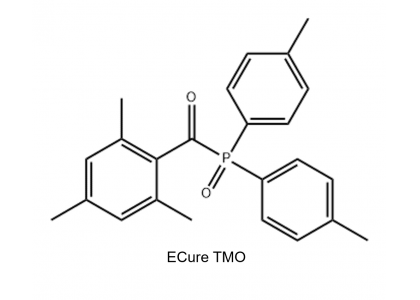
ECure TMO is an efficient, safe, and non-yellowing upgrade alternative to TPO, outperforming conventional 819 and TPO-L formulations in environmental friendliness, reactivity, and application compatibility—especially suitable for applications demanding high safety and color stability.
I. Core Advantages of ECure TMO over 819 and TPO-L
No reproductive toxicity, stronger regulatory compliance
TPO is classified as an SVHC (Substance of Very High Concern) by the EU due to its phenyl-phosphorus bond, posing a potential ban risk. ECure TMO lacks this structural feature, and its metabolite—benzoic acid—is naturally excretable. It has passed EU REACH, Korea’s KR-REACH, and UK new substance registration, making it suitable for sensitive applications like medical devices and food packaging.
Higher initiation efficiency, faster curing
Experimental data shows that ECure TMO’s initiation efficiency is slightly higher than TPO, with superior double-bond conversion rates, significantly shortening production cycles and improving line efficiency. In contrast, TPO-L has lower toxicity but much lower efficiency than TPO; 819 offers high efficiency but causes severe yellowing.
No yellowing, ideal for high color stability requirements
819 (BAPO) tends to yellow after curing, making it unsuitable for white or transparent systems. ECure TMO does not cause yellowing, making it particularly suitable for high-end packaging, optical components, and coatings for children's toys where color fidelity is critical.
Low migration, higher safety
ECure TMO demonstrates excellent migration stability in food packaging inks, meeting FDA certification requirements and ensuring safety for direct food contact. Its low volatility (≤0.2%) and lack of irritating odor also improve the working environment, aligning with green chemistry trends.
Strong compatibility, flexible formulation
ECure TMO dissolves well in acrylates and unsaturated polyesters, and can be used alone or in combination with other photoinitiators like 184 or BP, adapting to various formulation needs. It enables deep curing even in dark or thick coatings, avoiding the issue of "surface dry but inner uncured."
II. Why 819 and TPO-L Are Not Recommended as Mainstream Alternatives?
|
Photoinitiator |
Advantages |
Limitations |
Applicable Scenarios |
|
TPO-L |
Lower toxicity than TPO |
Low initiation efficiency, limits production speed |
White systems, low-yellowing-demanding applications |
|
819 (BAPO) |
High initiation efficiency |
Severe post-cure yellowing, unsuitable for light/transparent systems |
Dark plastic coatings, electronic housings, non-transparent applications |
|
ECure TMO |
High efficiency, non-toxic, no yellowing, low migration |
—— |
Ideal choice for fully replacing TPO |
Note: Neither TPO-L nor 819 can fully replace TPO, and are only viable in limited scenarios.
III. Practical Application Value of ECure TMO
Food packaging printing: Used in combination with TPO-L to meet both migration safety and low-yellowing requirements.
Medical devices and children's products: Its non-reproductive toxicity has enabled successful integration into UV inks and coatings for these sensitive applications.
High-speed digital printing: Cures 30%-50% faster than TPO, increasing production capacity by over 30%.
Preferred choice under UV LED curing trend: Strong absorption in the 365nm~405nm range makes it perfectly compatible with UV LED light sources, supporting eco-friendly transformation.