
Call us now:
86-22-8834 5196
LIFTCHEM-UV Curing Raw Materials, Pharmaceutical Intermediates
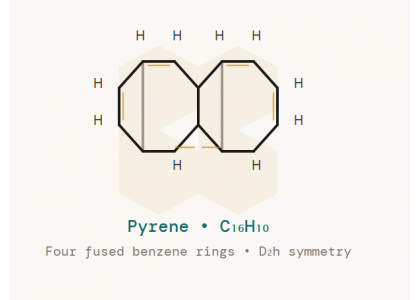
Pyrene is one of chemistry's quiet giants — a polycyclic aromatic hydrocarbon with a deceptively simple structure that has quietly accumulated an extraordinary portfolio of applications. From traditional dye synthesis to cutting-edge organic light-emitting diodes and field-effect transistors, this golden-green crystalline solid is redefining what molecules can do in an electronics-driven world.
Pyrene (CAS 129-00-0, systematic name benzo[def]phenanthrene) consists of four fused benzene rings arranged into a flat, symmetrical disc-like architecture — technically described as a D2h-symmetric polycyclic aromatic hydrocarbon. Its molecular formula is C₁₆H₁₀ with a molecular weight of 202.25 g/mol.
In its purest form, pyrene appears as a yellow-green to pale orange crystalline solid with a melting point of 148–152 °C and a boiling point of around 404 °C. It is sparingly soluble in water but dissolves readily in most organic solvents. It occurs naturally in coal tar, from which it is typically extracted by fractional distillation and recrystallization, and can also be obtained via the destructive hydrogenation of hard coal.
What truly distinguishes pyrene from other polycyclic aromatic hydrocarbons is its extended π-conjugation across all four rings, creating a delocalized electron cloud that gives it exceptional optical and electronic properties. This rigid planarity — sometimes described as a "discotic" geometry — enables strong π–π stacking interactions in the solid state, a characteristic that proves enormously useful in charge transport applications.
Long before its semiconductor potential was recognized, pyrene served as a foundational feedstock in the chemical industry. These established applications continue to represent a significant portion of global pyrene consumption today.
Pyrene undergoes acylation reactions to yield vat dyes including the commercially important Orange GR and related colorants used in textile and industrial dyeing applications.
Oxidation of pyrene yields 1,4,5,8-naphthalenetetracarboxylic acid, a key precursor for high-performance dyes, synthetic resins, and engineering plastics.
Pyrene and its derivatives have been used as active ingredients in insecticide formulations and as plasticizing agents in polymer processing.
Pyrene is a widely used fluorescent probe to determine critical micellar concentrations of surfactants and to study protein conformation by fluorescence spectroscopy.
Pyrene's long intrinsic fluorescence lifetime, combined with its lipophilic character and intense emission, made it an indispensable analytical tool in physical chemistry and biochemistry decades before the semiconductor industry took notice of it.
The past decade has witnessed a dramatic expansion in pyrene's role in advanced materials science, driven by its favorable electronic properties. Pyrene is classified as an aromatic discotic liquid crystal that exhibits photogeneration of electron-hole pairs — the fundamental process underlying light-emitting diodes, photovoltaic cells, and field-effect transistors. Critically, it functions as an ambipolar charge carrier, capable of transporting both electrons and holes, which opens doors to a wide range of device architectures.
The strong π–π interactions in the solid state facilitate efficient charge transport pathways, while pyrene's large, flat π-system does not require protection during functionalization — making it an exceptionally versatile building block for molecular engineering. Researchers can introduce donor and acceptor groups at the 1-, 2-, 3-, 4-, 6-, 7-, 8-, and 9-positions of the pyrene core to tune optical and electronic properties with remarkable precision.
Of all semiconductor applications, OLEDs represent pyrene's most commercially significant frontier. The OLED display industry has long grappled with what researchers call "the blue problem" — achieving simultaneously efficient, pure, and stable blue emission has proven far more challenging than red or green. Pyrene-based emitters have emerged as one of the most promising solution classes.
The rigid planar structure of the pyrene core delivers favorable π-electron flow and bright emission characteristics. By substituting donor and acceptor functional groups onto the pyrene scaffold, researchers have engineered materials that exhibit thermally activated delayed fluorescence (TADF), which converts normally wasted triplet excitons into radiative singlet excitons, breaking through the 25% internal quantum efficiency ceiling of conventional fluorescent emitters.
Research published in 2024 demonstrated that pyrene-core blue fluorescent materials with diphenylamine modifications at the 1,6-positions achieved external quantum efficiencies exceeding 5.8% alongside maximum current efficiencies of over 8.2 cd/A — representing meaningful advances toward commercial blue OLED standards.
The asymmetric pyrene-azaacene derivative PBCNT, reported in 2025, achieved a record EQE of 28.5% for solution-processed red OLEDs — a result enabled by pyrene's large planar conjugated structure and favorable HOMO-LUMO spatial separation characteristics.
Pyrene's strong π–π stacking in the solid state enables the efficient charge carrier mobility essential for transistor operation. Studies on covalent pyrene dimers have demonstrated photoluminescence quantum yields of up to 72% combined with hole mobilities of 32.6 cm² V⁻¹ s⁻¹ in single crystals — an impressive dual performance that has historically been extremely difficult to achieve simultaneously in organic semiconductors. This combination is essential for organic light-emitting transistors (OLETs), devices that could one day serve as electrically pumped organic lasers.
As electron-donor materials, pyrene derivatives are used to build donor-acceptor systems for energy conversion and light harvesting. The rigid structure of pyrene[4,5-d]imidazole-based organic dyes makes them particularly suitable for dye-sensitized solar cells (DSSCs). Pyrene-fused polycyclic aromatic regioisomers have shown columnar mesomorphism and strong tendencies toward face-on substrate orientation — exactly the molecular geometry needed for effective photocurrent generation in thin-film photovoltaic architectures.
Pyrene-based materials exhibit tunable fluorescence in response to environmental changes, making them exceptional fluorescent sensors in both biological and materials contexts. Their use as probes for critical micellar concentration determination extends naturally into nanomedicine applications, where pyrene-loaded nanoparticles have been studied for drug delivery, exploiting pyrene's well-characterized behavior in membrane environments.
Pyrene serves as a high-performance core for blue TADF and fluorescent OLED emitters, addressing the industry's most persistent efficiency and stability challenge.
Tunable environmental fluorescence response enables applications in chemical sensing, biosensing, and excimer-based detection systems.
Strong solid-state π–π interactions enable high carrier mobility in organic transistors and field-effect device active layers.
One of pyrene's most commercially valuable traits is the ease with which its structure can be chemically modified. The molecule's ten peripheral positions — symmetry-equivalent pairs at 1,2,3,4,5,6,7,8,9,10 — can be functionalized through electrophilic substitution, palladium-catalyzed cross-coupling reactions, and direct C–H functionalization. The K-region (the 4,5 bond) and peri positions (1,6 and 2,7) have proven especially useful for fusing additional aromatic systems to extend conjugation further.
This synthetic flexibility underlies the emergence of entire families of pyrene-based materials: pyrene-imidazole dyads for hot-exciton OLEDs, pyrene-azaacene derivatives for red TADF emitters, pyrene boronic acid esters for nanographene synthesis via Suzuki-Miyaura cross-coupling, and metal-organic framework building blocks that exploit pyrene's tetratopic coordination capability. Each modification produces a distinct set of photophysical and electronic properties, effectively giving chemists a highly tuneable platform molecule.